
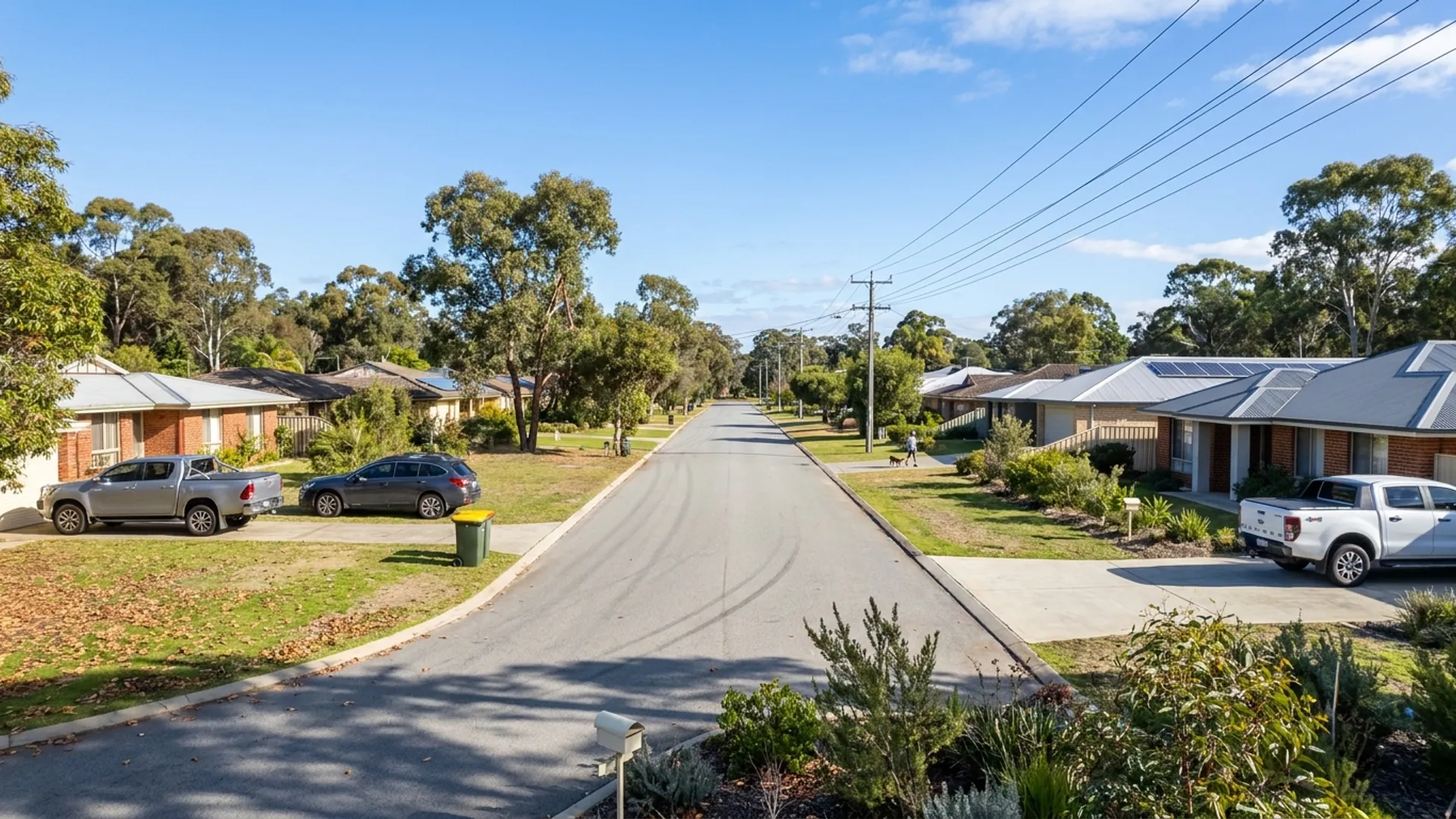
Building & Pest Inspections in Helena Valley
Helena Valley is a Darling Scarp suburb — and that distinction changes everything about how a building and pest inspection needs to be conducted. Unlike the flat, sand-and-clay coastal plain where most of Perth's suburbs are built, Helena Valley sits on laterite and ironstone over granite bedrock at the base and lower slopes of the Darling Scarp. The geology, the topography, the construction methods, and the pest pressures are fundamentally different to anything found on the coastal plain. An inspector who applies standard Perth metropolitan methods to a Helena Valley property will miss defects specific to scarp construction.
Homes in Helena Valley are built on large bush blocks — typically 2,000 to 10,000 square metres — surrounded by dense native bushland that is part of, or immediately adjacent to, national park and conservation estate. The majority of the housing stock dates from the 1980s through to the 2000s, with a mix of conventional brick-and-tile, pole homes built into steep terrain, split-level construction following the natural contour of the scarp, and timber-framed homes that are particularly vulnerable to termite and borer attack. This is not volume-built suburban housing — these are individually designed homes on challenging terrain, and each property requires a different approach.
The scarp environment creates building challenges that simply do not exist on the coastal plain. Steep terrain requires retaining walls — often substantial structures holding back metres of laterite and clay — that fail progressively over decades. Water runs off the scarp face through Helena Valley during winter, creating sustained moisture loading against foundations and retaining structures. Bushfire Attack Level (BAL) ratings apply to most properties, dictating construction requirements for any additions or modifications. And the surrounding bushland supports some of the most intense termite and pest pressure of any residential suburb in the Perth metropolitan area.
What We Look For in Helena Valley Properties
Retaining Wall Failures on Steep Terrain
Helena Valley's steep scarp terrain means most properties rely on retaining walls to create usable building platforms, driveways, and outdoor areas. These walls — ranging from timber sleeper walls to engineered limestone block and concrete structures — carry enormous loads on steep sites. Laterite soil is heavy when saturated, and winter water runoff from the scarp above adds hydrostatic pressure behind retaining walls that can exceed their design capacity. Common failures include leaning walls, cracking at the base, blown-out drainage weepholes, and soil movement behind the wall that affects the building platform above. A failing retaining wall on a steep Helena Valley site can compromise the home's foundation, undermine driveways, and create landslip risk on the block below. We assess every retaining wall for structural adequacy, drainage function, and signs of progressive failure.
Extreme Termite Risk from National Park Bushland
Helena Valley properties are surrounded by dense native bushland — mature jarrah, marri, and wandoo forest that supports some of the largest and most established subterranean termite colonies in the Perth metropolitan area. Unlike coastal suburbs where termite risk comes from relatively small retained vegetation corridors, Helena Valley homes sit within the termite colony's territory. The mature eucalyptus root systems in the surrounding forest extend well beneath residential properties, and termite foraging galleries follow these roots directly to the home. Homes with timber subfloor construction, timber framing, or timber cladding face the highest risk — and 1980s–1990s Helena Valley homes frequently incorporate these elements. We conduct thorough timber pest inspections at every Helena Valley property, including subfloor access where available, and use Termatrac detection technology where appropriate to identify concealed termite activity.
European House Borer (EHB) Risk
Helena Valley falls within the WA Department of Primary Industries' European House Borer awareness zone. EHB targets untreated seasoned pine — the same material used for roof trusses and framing in homes built from the 1970s through to the early 2000s. EHB larvae bore through pine framing for 3 to 11 years before emerging as adult beetles, meaning structural damage can be severe before any visible evidence appears on the timber surface. In Helena Valley's 1980s and 1990s housing stock, roof trusses are the primary concern. We inspect accessible roof spaces for EHB exit holes, frass (bore dust), and structural weakening of pine framing members.
Pole Homes & Split-Level Construction
Helena Valley's steep terrain has produced construction solutions rarely seen on the flat coastal plain — pole homes raised on steel or timber posts, split-level homes with multiple slab levels stepping down the slope, and homes with exposed subfloor areas that create large voids beneath the living space. Each of these construction types requires specific inspection techniques. Pole home foundations need assessment for corrosion (steel) or decay and termite damage (timber). Split-level homes have multiple slab-to-slab junctions where cracking and moisture penetration are common. Exposed subfloor areas provide direct termite access to floor framing and require thorough inspection for evidence of activity.
BAL Bushfire Ratings
Most Helena Valley properties carry Bushfire Attack Level ratings ranging from BAL-12.5 to BAL-FZ (Flame Zone). Any additions, modifications, or renovations to the home — including carports, pergolas, decking, and outbuildings — must comply with the applicable BAL rating under AS 3959. Our inspections identify existing structures that may not comply with current BAL requirements, which can affect insurance coverage and council approval for future works.
Precincts We Service
- Helena Valley Upper (Scarp Face) — steep terrain, pole homes and split-level construction, extreme BAL ratings, retaining wall assessment, laterite over granite geology
- Helena Valley Lower (Scarp Base) — transitional terrain, 1980s–1990s brick-and-tile on large bush blocks, national park bushland interface, extreme termite pressure
- Scott Street & Ridge Hill Road — established bush residential, mature tree root encroachment on foundations, EHB risk in pine-framed homes
- Helena Valley Road Corridor — larger rural-residential properties, mixed construction types, heritage-era stock with asbestos risk, outbuildings and sheds
Pest Control in Helena Valley
Helena Valley faces the most extreme pest pressure of any suburb in the Ellenbrook service area — not because of development displacement, but because the suburb is embedded within the pest population's natural habitat. National park bushland, mature eucalyptus forest, and undisturbed native vegetation surround every property in Helena Valley. Subterranean termites, bush cockroaches, redback spiders, huntsman spiders, scorpions, centipedes, dugite snakes, and a range of native wildlife are permanent residents of the scarp environment. Managing pest pressure in Helena Valley is an ongoing commitment, not a one-off treatment.
Subterranean termite risk in Helena Valley is extreme. The mature jarrah, marri, and wandoo trees in the surrounding forest provide massive food sources that sustain large colonies, and the foraging galleries from these colonies extend beneath residential properties through the root systems that penetrate the laterite soil. The humid, shaded conditions on the scarp face — with dense tree canopy, leaf litter, and minimal air movement — create ideal conditions for termite colony expansion. Homes with any timber-to-ground contact, timber subfloor framing, timber cladding, or timber retaining walls are at critical risk. We provide annual termite inspections from $189 and recommend them for every Helena Valley property without exception. General pest control treatments for spiders, cockroaches, ants, and rodents also start from $189.