
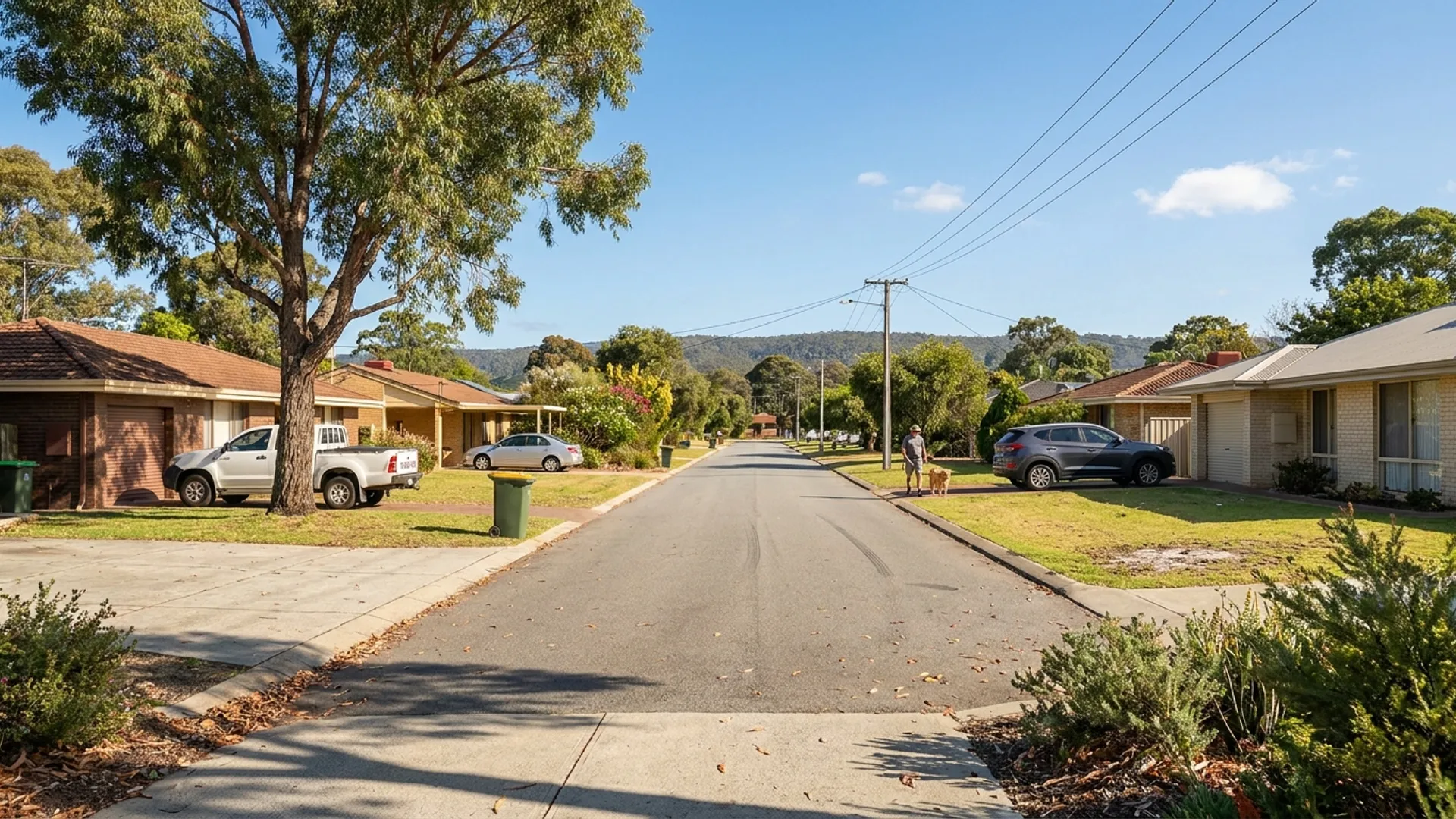
Building & Pest Inspections in Forrestfield
Forrestfield sits at the base of the Darling Scarp — and that position gives it the worst of both worlds from a building inspection perspective. The suburb is built on Guildford Formation reactive clay, the same problematic soil that affects Perth's entire eastern corridor. But unlike flat suburban areas where clay behaviour is driven solely by rainfall and drainage, Forrestfield's clay also receives water runoff from the scarp above. Winter rainfall runs off the granite and laterite scarp face, flows down through the foothills, and saturates the clay beneath Forrestfield's homes for months longer than equivalent soils on the flat coastal plain. This prolonged saturation amplifies the reactive clay cycle and creates foundation problems that develop faster and more severely than in suburbs away from the scarp base.
The majority of Forrestfield's housing stock dates from the 1970s and 1980s — the era of brick-and-tile construction that dominates Perth's established suburbs. These homes are now 40 to 50 years old, and the combination of aging construction, reactive clay foundation movement over decades, and extreme termite pressure from the adjacent scarp bushland makes Forrestfield one of the most technically demanding suburbs we inspect. Add to that the high prevalence of asbestos-containing materials in the 1970s stock — fibro-cement eaves, fencing, wet-area linings, and gable cladding — and a thorough pre-purchase building and pest inspection becomes essential for any buyer in this suburb.
Forrestfield is also undergoing significant change. The Metronet Forrestfield-Airport Link has brought a new train station to the suburb, driving rezoning of surrounding properties for medium-density development. This creates a transitional market where established 1970s homes on large lots are being purchased for renovation, subdivision, or demolition and rebuild. Understanding the true condition of an established Forrestfield property — including hidden defects, asbestos extent, and structural adequacy for renovation — is critical information for buyers in this changing market.
What We Look For in Forrestfield Properties
Scarp-Base Reactive Clay — Amplified Foundation Movement
Forrestfield's position at the scarp base means its Guildford Formation clay receives moisture from two sources: direct rainfall and surface/subsurface runoff from the Darling Scarp above. This dual moisture loading keeps the clay saturated longer than equivalent soils on the flat plain, amplifying the shrink-swell cycle that damages concrete slab foundations. After four to five decades of this cycle, many Forrestfield homes show significant evidence of foundation movement: diagonal cracking radiating from window and door corners, doors and windows that bind or fail to close properly, visible floor slope, and separation between walls and ceilings. Our inspectors use laser levelling to measure slab variation across the floor plan and correlate the findings with external factors — drainage direction, garden moisture, proximity to the scarp face, and retaining wall condition — to assess whether the movement is active and progressive or historic and stable.
High Asbestos Prevalence in 1970s–1980s Stock
Forrestfield's dominant housing era — the 1970s and 1980s — coincides with the peak period of asbestos-containing material use in Australian residential construction. Fibro-cement eaves soffits, gable-end cladding, fence sheets, bathroom and laundry wall linings, and some flooring materials in Forrestfield homes frequently contain asbestos. While undisturbed asbestos in good condition presents limited risk, any renovation, demolition, or deterioration creates potential exposure. For buyers planning to renovate a Forrestfield property — particularly those considering the subdivision or redevelopment opportunities created by the Metronet rezoning — understanding the location and extent of asbestos-containing materials is essential cost information. Our inspections identify the location and condition of suspected asbestos-containing materials and note areas requiring professional testing.
Extreme Termite Pressure from Scarp Bushland
The Darling Scarp bushland rises directly behind Forrestfield's eastern properties. Mature jarrah, marri, and wandoo forest supports established subterranean termite colonies whose foraging galleries extend down the scarp face and into the suburb. The sustained soil moisture from scarp runoff creates ideal conditions for termite movement year-round — unlike drier coastal suburbs where termite activity reduces in summer, Forrestfield's scarp-base position maintains moisture levels that support continuous termite foraging. Homes on the eastern edge of the suburb, closest to the scarp, face the highest risk, but foraging galleries can extend hundreds of metres from the colony, meaning properties throughout Forrestfield are affected. We conduct thorough timber pest inspections at every Forrestfield property, with particular attention to subfloor areas, roof spaces, and any timber-to-ground contact.
European House Borer (EHB) in 1970s–1980s Roof Trusses
Forrestfield falls within the EHB awareness zone, and the suburb's dominant 1970s–1980s housing stock is the era most vulnerable to European House Borer infestation. Untreated seasoned pine — used extensively for roof trusses and framing during this period — is the primary target for EHB larvae, which bore through the timber for 3 to 11 years before emerging. In Forrestfield's aging roof spaces, EHB damage can go undetected for years because homeowners rarely inspect their roof cavities. Our inspections include accessible roof space assessment for EHB exit holes, frass accumulation, and structural weakening of truss members.
Perth Airport Flight Path Impacts
Forrestfield sits beneath Perth Airport's flight path for its secondary runway. While this does not directly cause building defects, the sustained vibration from aircraft — particularly lower-altitude approaches — can accelerate existing cracking in homes already affected by reactive clay movement. Homes with pre-existing foundation stress from the clay cycle experience incremental widening of cracks over time in flight-path zones. We note flight-path proximity and assess whether vibration is a contributing factor to observed cracking patterns.
Precincts We Service
- Forrestfield East (Scarp Base) — direct bushland interface, extreme termite pressure, scarp runoff moisture loading, retaining walls on sloping sites
- Forrestfield Central (Established) — 1970s–1980s brick-and-tile, high asbestos prevalence, decades of reactive clay foundation movement, aging construction
- Forrestfield Station Precinct (Metronet) — rezoning and redevelopment zone, medium-density infill, renovation suitability assessment, asbestos extent for demolition planning
- Hale Road & Berkshire Road Corridor — mixed housing stock, flight path proximity, commercial-residential interface, drainage assessment on arterial road frontage
Pest Control in Forrestfield
Forrestfield's pest pressure is driven by the permanent Darling Scarp bushland interface — not by temporary development displacement. The mature forest behind the suburb supports established populations of subterranean termites, bush cockroaches, redback spiders, huntsman spiders, scorpions, and rodents. These populations use the bushland corridor as permanent habitat and migrate into adjacent residential properties year-round. Properties on the eastern edge of Forrestfield, directly below the scarp face, experience the most intense pressure, but the entire suburb is within foraging range of scarp-based termite colonies.
The combination of sustained scarp-runoff moisture, mature tree root systems extending beneath homes, and 40-year-old construction with aging barriers makes Forrestfield a critical suburb for annual termite inspections. Many of the original chemical termite barriers installed during construction in the 1970s and 1980s have long since degraded, leaving homes with no active barrier protection. Our pest control services cover general pest treatments for spiders, cockroaches, ants, and rodents from $189, as well as termite inspections, termite treatments, and barrier installation for properties that need their protection restored.