Building & Pest Inspections in Mandurah
Mandurah presents the most geologically complex inspection environment in PinPoint's service area. All four major Perth soil types are present depending on location: Quindalup Dunes on the immediate coastal fringe, Spearwood Dunes with Tamala Limestone through central Mandurah and Halls Head, Bassendean Sand inland toward Greenfields, and Guildford Formation clay further east toward Ravenswood. Canal estate properties sit on estuarine mud and engineered fill — a completely different foundation environment again. This geological diversity means two properties in Mandurah can have fundamentally different building challenges, making local inspection knowledge essential.
The Peel-Harvey Estuary — one of Western Australia's largest estuarine systems — dominates Mandurah's environment, creating high ambient humidity, sustained moisture pressure on buildings, and one of the most active termite environments south of Perth. The Serpentine and Murray Rivers add additional riparian corridors where mature trees harbour termite colonies that forage into adjacent residential properties.
What We Look For in Mandurah Properties
Canal Estate — Dual Salt Exposure and Concrete Spalling
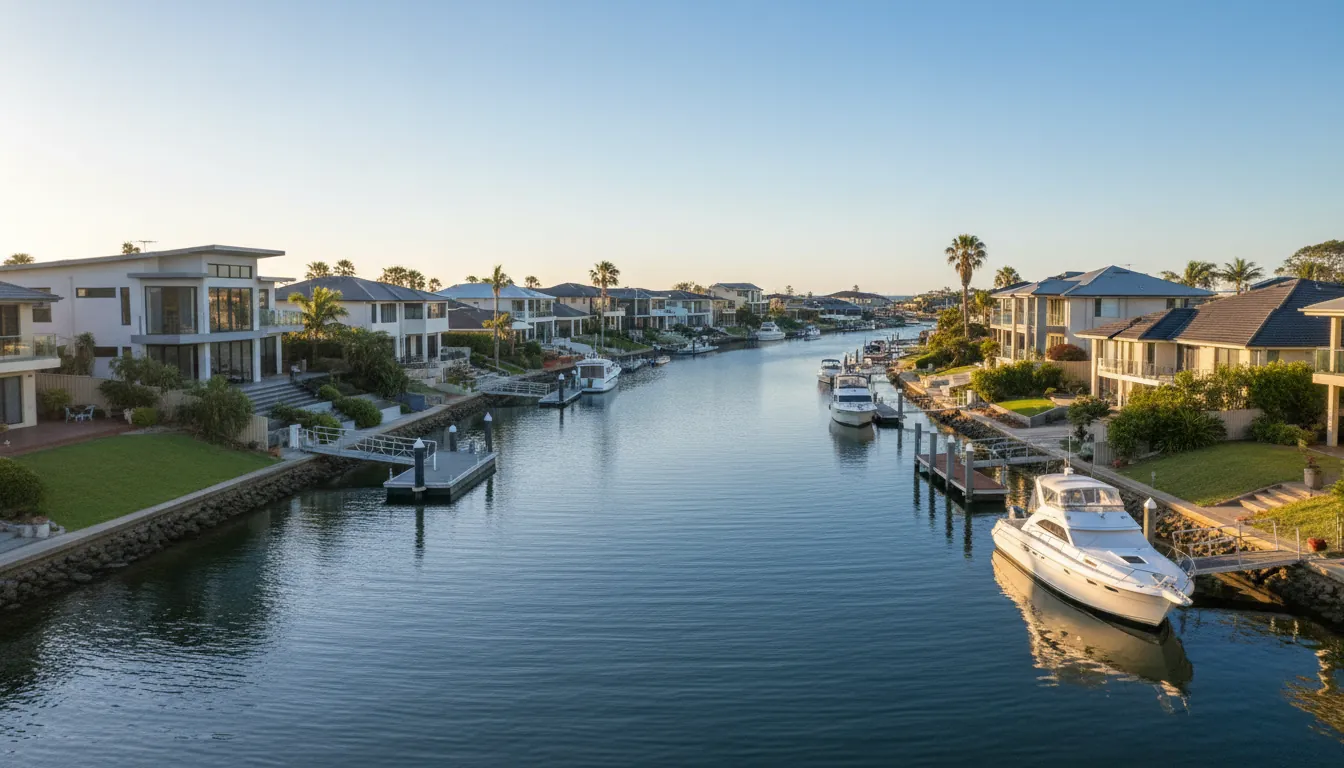
Mandurah's canal estates — Port Mandurah, Waterside Canals, and the Halls Head canal network — face unique inspection challenges. Properties are exposed to salt from both the Indian Ocean and the Peel Inlet, creating an aggressive corrosive environment. Concrete spalling ("concrete cancer") on balconies, slab edges, and canal retaining walls is the signature defect — corroding reinforcement from salt water exposure causes concrete to crack and fall away. Canal retaining wall condition is a critical assessment: subsidence, tie-back failure, and undermining from tidal action can affect the structural support of the property above. Our inspectors assess canal wall condition, concrete integrity, and the overall impact of the dual-salt environment on building components.
Estuary-Driven Rising Damp and Timber Decay
The Peel-Harvey Estuary creates high ambient humidity across Mandurah that accelerates timber deterioration. Alfresco areas, eaves, window frames, and pergola timbers decay faster here than in drier Perth suburbs. In 1970s–1980s double-brick homes, compromised damp-proof courses combined with high water tables cause rising damp — efflorescence, fretting brickwork, and bubbling plaster at the base of walls. Reticulation over-spray on established properties compounds the moisture issue. Our inspectors assess moisture levels throughout the property and identify whether issues stem from groundwater, lateral penetration, or the high ambient humidity.
Differential Settlement in Estuarine Areas
Properties built on reclaimed land or the peaty Safety Bay Sands near the estuary can experience differential settlement — the variable ground conditions cause different parts of the slab to settle at different rates. This produces stepped cracking in masonry, doors binding in frames, and visible gaps between floor and skirting boards. The inland areas toward Greenfields and Barragup, where Bassendean Sand interspersed with swampy peaty deposits meets the Guildford Formation clay, are particularly susceptible. Our inspectors assess cracking patterns to determine whether settlement is historical or active.
1950s–1970s "Mandurah Shacks" — Heritage Stock
Central Mandurah, Dudley Park, and Silver Sands retain pockets of original "Mandurah Shacks" — timber-framed cottages on limestone stumps or timber piles, clad in asbestos cement, weatherboard, or fibro. These properties are being rapidly cleared for subdivision, but some survive as renovation projects. Asbestos is pervasive in these older homes — Super Six roofing, flat-sheet cladding, eaves, and wet area linings. Buried asbestos debris in yards where old shacks were demolished for 1990s subdivisions is also a documented issue. Our inspections identify likely asbestos locations and assess structural viability.
Precincts We Service
- Port Mandurah Canals (Halls Head) — 1990s luxury canal homes, concrete spalling, canal wall assessment, complex multi-level roofs
- Waterside Canals (Dudley Park) — 1980s stock, deteriorating roof plumbing, corroded lintels, timber decay from estuary humidity
- Mandurah Ocean Marina — high-density modern apartments and townhouses, strata defects, waterproof membrane failures
- Meadow Springs — 1990s–2000s golf course estate, heavy termite pressure from course trees and lakes
- Greenfields / Coodanup — 1980s–1990s affordable housing, DIY renovations, unapproved structures, legacy asbestos
- Central Mandurah / Dudley Park — mixed stock, subdivision activity, fibro shack demolition and triplex development
Practical Completion Inspections (PCI) in Mandurah
Mandurah continues to see new residential development — waterfront apartments, canal-side townhouses, and suburban infill across the broader Mandurah area. New builds in this estuarine environment face specific challenges: high water table waterproofing, salt-resistant material selection, and foundation engineering on variable ground conditions. Our practical completion inspections verify that waterproofing membranes are correctly installed in wet areas and on balconies (critical in Mandurah's high-humidity environment), that drainage systems adequately handle the high water table, and that the building envelope is sealed against moisture penetration. PCI inspections start from $465.
Pest Control in Mandurah
Mandurah's pest environment is among the most intense in PinPoint's service area. The Peel-Harvey Estuary creates high ambient humidity and sustained soil moisture that supports year-round termite activity. Coptotermes acinaciformis, Coptotermes frenchi, and Heterotermes species are all present. The Serpentine and Murray Rivers — with their riparian corridors of mature eucalyptus and melaleuca — provide extensive nesting habitat for termite colonies that forage deep into residential areas. The vast majority of 1980s–2000s homes feature untreated pine roof timbers — attractive feeding sites for termites that breach the building envelope.
The estuarine environment accelerates timber fungal decay (wood rot) in alfresco areas, eaves, and window frames, creating conditions that attract dampwood termites and borers in addition to subterranean species. Coastal roof voids are frequently inhabited by rodents — check for chewed electrical wiring. Midge and mosquito pressure from the estuary is extreme during warmer months. Our pest control services start from $189, with annual termite inspections from $189 — essential for every Mandurah property given the extreme environmental pest pressure from the estuary and river systems.